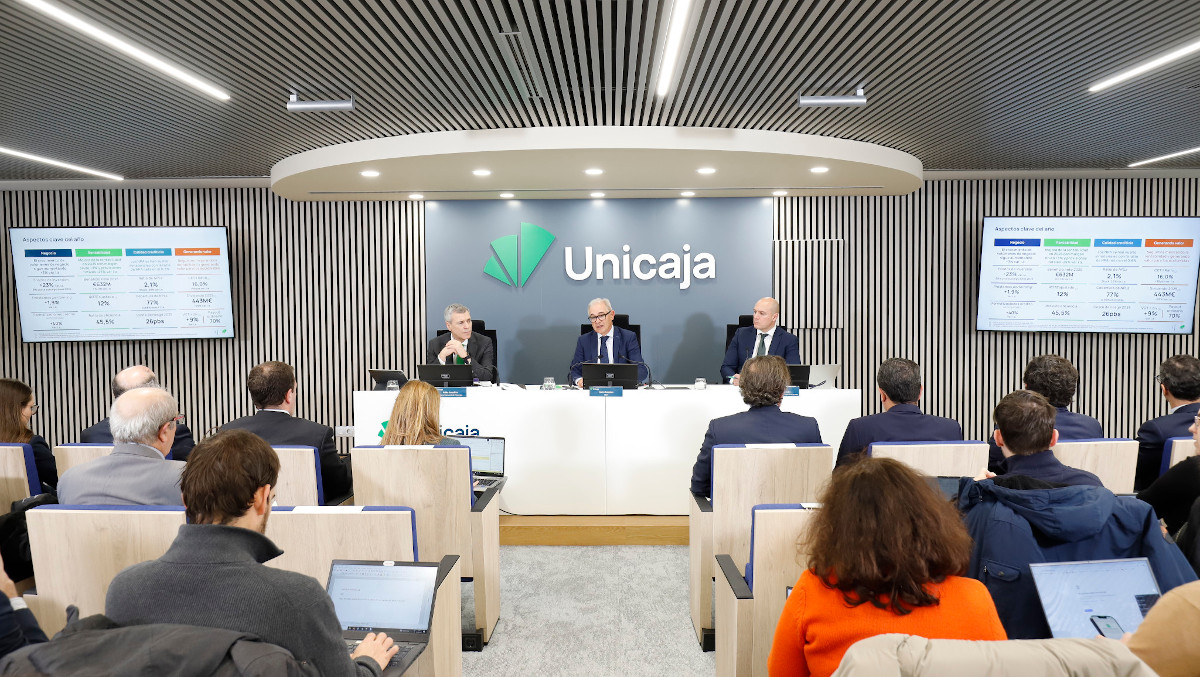
Grupo Unicaja posted a net profit of €632 million in 2025, compared to €573 million the previous year, representing an increase of 10.3%. This result is supported by a robust interest margin of €1,495 million, as well as growth in net fees (2.8% year-on-year) and a reduction in the item 'Provisions or reversal of provisions' and 'Other operating income and expenses', which included the temporary tax on credit institutions[1] (€88 million in 2024).
The bank has met all the guidance communicated to the market in terms of key metrics, thanks to the implementation of the 2025-2027 Strategic Plan, which drives commercial momentum, with a 3% increase in customer turnover for the year. In fact, net profit and net interest income exceeded the initial guidance by 26% and 7%, respectively. The higher growth in gross margin (2.6% year-on-year) has allowed the efficiency ratio to remain stable at 45.5%, despite a 5.3% year-on-year increase in administrative expenses.
Meanwhile, the ROTE profitability ratio, adjusted for excess capital, improved by 1.3 p.p. compared to December 2024, reaching 12.1%.
The improvement in profitability and the positive performance of the business have enabled the guidance communicated to the market to be revised upwards, raising the forecast for accumulated net income for the 2025-2027 cycle by 19%, to over €1,900 million (compared to the €1,600 million initially estimated) and with a shareholder remuneration of over 85%.
For the 2026-2027 period, the bank has also updated its targets and forecasts a ROCET1 (return on regulatory capital) of over 15% (compared to the previous figure of over 13%), a net interest income of over €1,500 million (compared to the €1,400 million forecast), and net profit expected to exceed €630 million, up from the more than €500 million initially estimated.
In January, Unicaja's Board of Directors approved an update to the dividend policy that raises the distribution target to 70% of net profit, up from the previous 60%, and adds the possibility that the Board of Directors, when publishing results, may specify additional remuneration above the said 70% target. Accordingly, for 2026 and 2027, the Board of Directors considers the possibility of additional remuneration through the buyback of own shares or additional dividends, estimated for the current financial year at around 25% of the group's consolidated net profit for this year. Even with this increase in distribution, Unicaja maintains a comfortable capital position, well above regulatory requirements.
With this update, the bank will distribute a dividend of €443 million charged to the 2025 results. This amount includes the €169 million paid in September 2025, as well as a dividend of €274 million that the bank will propose to the General Shareholders' Meeting for approval.
Balance sheet and activity
3.5% year-on-year growth in customer funds under management
Customer funds, including wholesale, continue to perform well, with an increase of 2.9% over the last twelve months to €104,902 million. Retail funds amount to €96,789 million, with a year-on-year increase of 3.5% and strong growth in off-balance sheet funds, which rose by 13.8% to €25,697 million.
Among savings products, mutual funds performed particularly well, recording year-on-year growth of 22.6%, with accumulated assets at the end of 2025 of €16,585 million and net subscriptions of €2,801 million, 59% more than in the previous year. The market share stands at 9%, according to data from Inverco.
The balance of performing loans increased by 1.9% during the year to €47,245 million, thus returning to a path of growth with a low risk profile. The implementation of the Strategic Plan, which places corporate and consumer lending as key drivers for revenue diversification, reflects growth of 3.7% and 8.3%, respectively, in these segments.
In 2025, new lending reached €12,133 million, of which €3,087 million was in mortgages to individuals, accounting for 25.4% of the total. New lending to the private sector saw a year-on-year increase of 40%, with strong growth across all portfolios.
Improvement in balance sheet quality and progress in risk indicators
The results for the year are also accompanied by an improvement in balance sheet quality, demonstrating the strength of the business model.
The NPL ratio fell by 10 basis points in the quarter and 57 basis points in the last twelve months to 2.14%. The cost of risk remained contained at 26 basis points for the year.
The volume of non-performing assets (NPAs) fell by 25.3%, with decreases of 32.9% in foreclosed assets and 20.0% in NPL. Credit quality can be seen in aspects such as the evolution of new doubtful loans, which fell by 20.4% in the last quarter.
The reduction in NPAs has been accompanied by a strengthening of the already high levels of coverage, which are among the highest in the sector, continuing Unicaja's traditional policy of prudence. The coverage ratio for non-performing assets stands at 76.7%, and that for NPL at 77.1%, while the coverage ratio for foreclosed assets stands at 76.1%. The sharp reduction in NPAs and the increase in coverage have resulted in a 40% year-on-year fall in net NPAs.
Capital and liquidity management
CET 1 at 16% and comfortable liquidity position
Unicaja maintains high and solid levels of solvency and[2] , with a CET 1 (Common Equity Tier 1) of 16%, a Tier 1 capital ratio of 17.9% and a total capital ratio of 19.9%. The bank therefore has €2,197 million in excess of regulatory requirements, thanks to organic earnings generation and including a payout of 70%.
The bank maintains a solid liquidity position, reflected in the loan-to-deposit ratio, which stood at 68%, a short-term liquidity ratio (LCR) of 301% and a net stable funding ratio (NSFR) of 160%.
Profit and loss account
Gross margin grows by 2.6% year-on-year
Net interest income remained solid, supported by lower deposit costs and strong wholesale investment performance. Income from fixed income, savings in wholesale issuance costs and the maturity of mortgage bonds contributed to net interest income reaching €1,495 million at year-end (+1% quarter-on-quarter).
Net fees reached €527 million at year-end, a year-on-year increase of 2.8%. The positive commercial momentum led to an increase in assets under management, especially in mutual funds, whose net fees rose by 19.6% year-on-year. Insurance fees also performed well, rising by 4.2% year-on-year.
Gross income grew by 2.6% to €2,095 million, and the efficiency ratio stood at 45.5%. ROTE, adjusted for excess capital, improved by 1.3 p.p. to 12.1%.
Pre-provision profit amounted to €1,141 million for the year, while loan loss provisions increased by 12.3%. Other provisions/impairments decreased substantially during the year (-25% year-on-year).
Pre-tax profit amounted to €902 million, with a net profit of €632 million. The income tax expense line includes the accrual of the Tax on Interest and Commission Margin.
Artificial Intelligence
In the area of digital transformation, Unicaja continues to make progress in incorporating Artificial Intelligence as a strategic lever to further improve the experience of both customers and employees, while increasing operational efficiency.
The bank is deploying use cases that drive commercial acceleration -especially in mortgages and insurance-, optimise key processes such as complaint handling, legal processes an administrative tasks, and significantly reduce time to market in technological development for legacy systems. This progress is supported by the AI Hub, which brings together more than 50 specialised professionals, and by partnerships with universities for the development of Responsible AI in Finance, promoting research and talent recruitment.
Unicaja has also implemented a hybrid, modular architecture that is ready to operate in both cloud and on-premise environments and is compatible with commercial and open source models. All of this is part of a cross-cutting, responsible AI adoption process, backed by training programmes for the entire organisation, which is already delivering efficiency improvements of over 50%.
Sustainability
Unicaja has reinforced its responsible banking strategy, achieving AENOR Gender Equality certification (the first listed Spanish financial institution to do so) and improving its ESG ratings.
In addition, in sustainable business, agreements have been signed to facilitate access to public aid, notably the guarantee agreement with the European Investment Bank (EIB) that will enable up to €400 million in financing to be mobilised for SMEs and mid-caps.
The bank continues to support the agricultural and livestock sector, sport, culture and financial education, promoting various projects during the quarter.
[1] This tax has been replaced by a tax on net interest income and fees, which Unicaja has accrued in the income tax section.
[2] Capital ratios include net profit, less accrued dividends, subject to approval by the European Central Bank.
Download here the charts asociados a la presentación de resultados.
To view a video summary of the Unicaja CEO, Isidro Rubiales, click here.