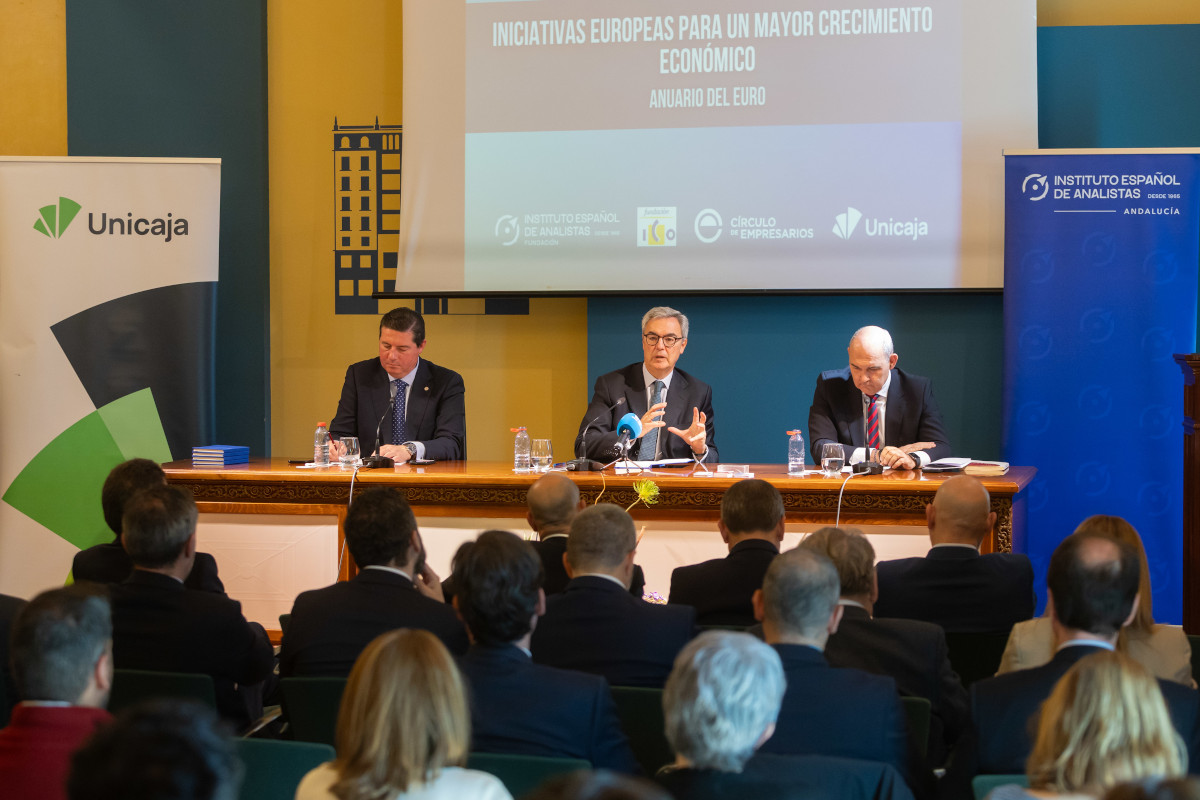
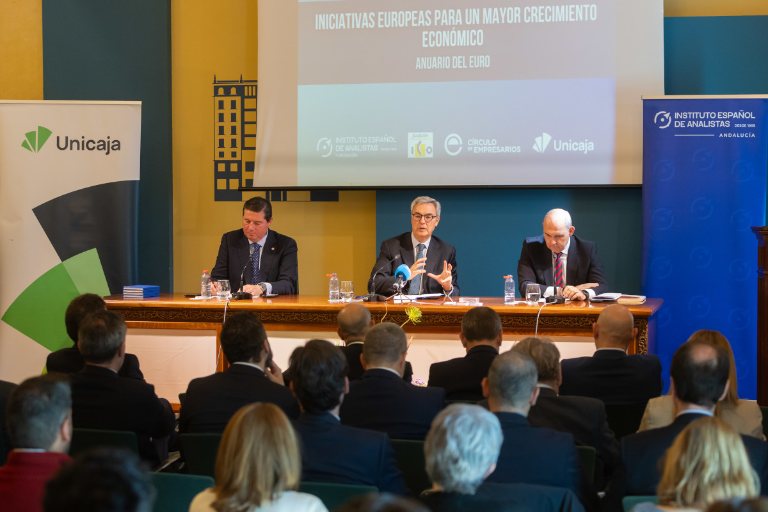
On Wednesday 11 March, the city of Málaga hosted the event ‘European Initiatives for Greater Economic Growth’, organised by the Instituto Español de Analistas, which was attended by the chairman of Unicaja, José Sevilla. The event provided an opportunity to launch the Euro 2025 Yearbook in Andalusia.
During the event, Sevilla took part in a discussion with the Institute’s Director of Research and Analysis, Francisco Uría, to address the role of European initiatives in driving economic growth in the current international context.
Unicaja’s participation in this forum reflects its commitment to fostering spaces for analysis and reflection on major economic and financial challenges. Through its collaboration with initiatives promoted by organisations such as the Spanish Institute of Analysts, the bank reaffirms its support for the generation of knowledge, dialogue between institutions and the search for solutions that contribute to strengthening economic growth, financial stability and sustainable development at European level.
During the meeting, the Spanish Institute of Analysts identified low productivity, economic fragmentation and the need to mobilise more investment as the main obstacles to European growth. The event focused on a central idea: the European Union needs to accelerate reforms that strengthen its competitiveness, improve the allocation of savings and boost its growth potential in an increasingly demanding international context.
In his welcome address, Carlos Bocanegra, president of the Andalusian branch of the Spanish Institute of Analysts, emphasised that “Europe is facing a decisive and stage in which progress on integration, investment and competitiveness will be key to sustaining growth. With this meeting, we aim to bring this debate to Andalusia with the help of leading figures from the economic and financial sectors”.
For his part, Uría presented the main conclusions of the Anuario del Euro 2025. Repensar la UE. Consolidar la UEM en un mundo fracturado (Euro 2025 Yearbook: Rethinking the EU. Consolidating EMU in a Fractured World), a publication which, in its twelfth edition, analyses, among other issues, the new geopolitical context, lower productivity growth in the eurozone compared to the United States, the challenges facing public finances under the new fiscal rules, and the competitiveness of the European financial system.
Dialogue
The dialogue between Uría and Sevilla centred on the initiatives Europe needs to regain economic dynamism and strengthen its position vis-à-vis other major economies. Both identified as priorities the improvement of the investment framework, greater market integration, and an environment that allows the financial system to channel savings more efficiently into the productive economy. The conversation also addressed the impact of the new geopolitical context and recent market developments, as well as the role the European financial sector can play in financing the continent’s major economic transformations.
Francisco Uría noted that “Europe needs to strengthen its growth potential through reforms that boost productivity, encourage investment and reduce the inefficiencies that still limit its competitiveness”.
For his part, José Sevilla stated that “the banking sector is in an ideal position to finance Europe’s growth, but a framework is needed that simplifies regulation and incentivises companies to invest in transformative projects”.
This debate ties in with one of the Yearbook’s key arguments: the European Union must press ahead with structural reforms if it is to respond more effectively to a landscape shaped by global competition, the energy transition, digitalisation and new demands for scale.
The event in Málaga forms part of a series of meetings organised by the Spanish Institute of Analysts, dedicated to different chapters of the Euro 2025 Yearbook, alongside authors and representatives from the economic, academic and institutional spheres. After twelve editions, the publication has established itself as one of the leading forums for analysis on the future of the euro, European integration and the major economic challenges facing the Union.
Twelve years analysing the major challenges facing the euro
The Euro Yearbook 2025: Rethinking the EU. Consolidating EMU in a Fractured World is the twelfth edition of a leading European publication on economic and monetary union and the major challenges of European integration. Edited by the economist Fernando Fernández Méndez de Andés, the yearbook is produced jointly by the Spanish Institute of Analysts Foundation, the ICO Foundation and, for the first time, the Círculo de Empresarios, which joins this edition as a collaborating partner in its production.
The 2025 edition is structured into several sections addressing, among other topics, the new geopolitical context and Europe’s role in a fractured world, the problem of low productivity growth in the eurozone compared to the United States, the lessons from the latest bout of inflation for the ECB’s monetary policy, and the challenges of public finance sustainability within the framework of the new European fiscal rules. The yearbook also analyses the situation in France and Germany, the competitiveness and regulation of the European financial system, and the impact of digital finance, including the digital euro project and the regulation of crypto-assets.