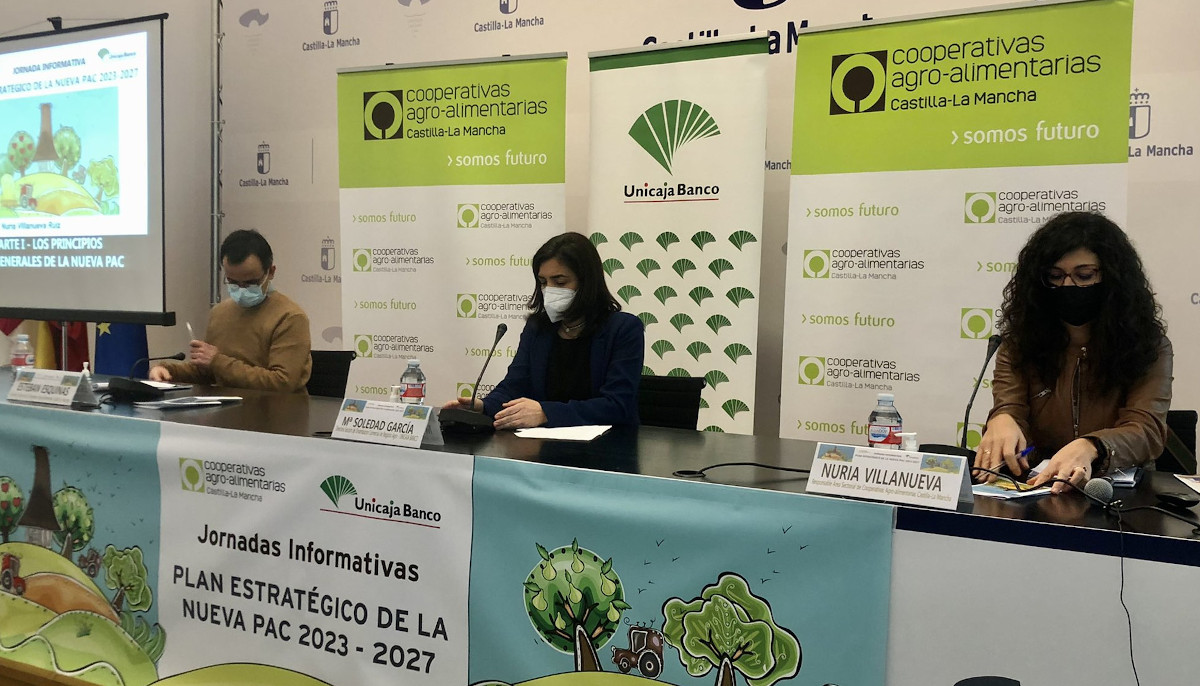
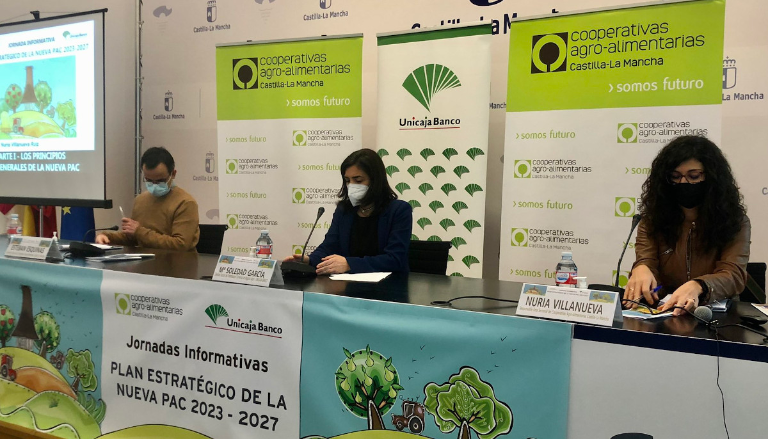
Unicaja Banco has collaborated with Cooperativas Agro-alimentarias Castilla-La Mancha in the information day 'Plan estratégico de la nueva PAC 2023-2027' (New CAP Strategic Plan 2023-2027), held on Wednesday in Toledo and with the participation of some fifty farmers, cooperatives and agri-food industries to learn the new basis of the aids and challenges towards a new more sustainable model of agriculture.
The workshop has been opened by the sectoral technician of Cooperativas Agro-alimentarias CLM, Nuria Villanueva, and by the Head of Commercial Development for Agriculture at Unicaja Banco, María Soledad García.
The bank’s representative has remarked Unicaja Banco’s commitment to the development of farming in the region, providing tools, knowledge and experience to face new challenges and to get the most of the opportunities that may arise in this time of change for the agri-food industry.
In fact, Unicaja Banco continues to work to provide support to the agri-food sector in Castilla-La Mancha and, especially, in Toledo, where the bank has a long-standing trajectory of collaboration with these professionals.
Likewise, the Head of Commercial Development for Agriculture at Unicaja Banco has thanked Cooperativas Agro-alimentarias Castilla-La Mancha for their commitment to this kind of initiatives, which are so much needed at this moment.
Quality, security and environment
The representatives of Cooperativas Agro-alimentarias Castilla-La Mancha have stated that ‘we have one year, 2022, to understand important conceptual changes, such as the new definition of active farmer or the new capping, which will modify the access to aids, or the conversion of payment regions according to changes in crops in recent years, or the effects of the redistribution of income support’.
'As well as -they added- the eco-schemes we can apply for, which will influence the support for a holding. All of the above while maintaining an advanced agriculture in terms of quality systems, food security and environment-friendly'.
In addition to the above, Nuria Villanueva has covered topics such as funds and measures in the Rural Development Program and has made a general review of the new aid system.
Esteban Esquinas, from Technical Services of Cooperativas Agro-alimentarias Castilla-La Mancha, has informed the participants about the 'Environmental architecture of the new CAP: eco-schemes and strengthened conditionality’, and about ‘Aids linked to the different sectors in the CAP'.
'Eco-schemes and linked aids involve 38% of the CAP’s first pillar budget, as the holding income will depend to a large extent on its knowledge and crop planning for the next autumn’, he said.