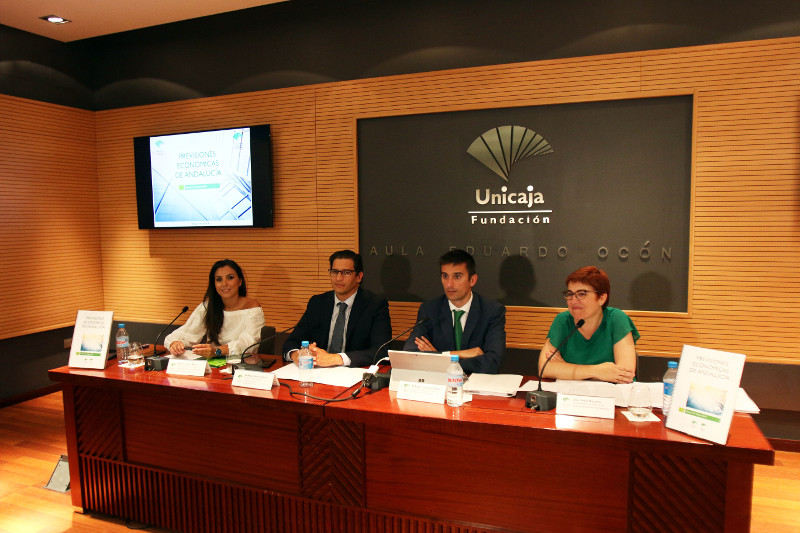
The issue number 93 of the quarterly report ‘Previsiones Económicas de Andalucía’ (Economic Forecast for Andalusia), corresponding to Summer 2018, has been published. This report has been prepared, as in previous editions, by Analistas Económicos de Andalucía (research company of Grupo Unicaja) and sponsored by the Foundation. It has been presented today at the Sala Unicaja de Conciertos María Cristina, in Malaga.
The report, which analyses the recent evolution of domestic and international economies, of Andalusia and its provinces, includes the growth forecasts for the GDP and its components in 2018, as well as the main variables of the labour market for Spain and Andalusia, with growth estimations for each Andalusian province.
Economic Environment (international and Spanish economy)
The world economy maintains a remarkable growth rate, boosted by the reactivation of trade and investment. However, this favourable scenario may be affected by certain risk factors, such as the adoption of protectionist measures in international trade relations. The expected growth for 2018 and 2019 may exceed in half point those registered in 2016 and 2017.
During the first quarter of the year, the Spanish economy continued with its growth trend. The GDP posted a year-on-year growth of 3.0%, driven by the strength of the internal demand and, in particular, of household consumption. However, the most recent perspectives expect a growth of 2.7%-2.8% for the whole 2018.
Andalusian Economy
The latest information, related to the first quarter of 2018, shows that the Andalusian economy recorded a quarter-on-quarter growth of 0.6%, 0.1% less than in the previous quarter. Year-on-year GDP growth stood at 2.9% (3.1% in the fourth quarter of 2017).
Considering its composition, from the point of view of demand, the contribution of the internal components stood at 2.9 p.p., 0.6 p.p. less than in the previous quarter, due mainly to the slower pace of growth of investments (3.8%), whereas household expenditure grew by 2.8%, a similar rate to that of the previous quarter. Public Administration expenditure grew by 1.8%. The contribution of net external balance to regional growth was zero, after two consecutive quarters of negative contribution, due to imports growing at slower pace (4.1%) than exports (4.6%).
From the point of view of supply, all the sectors registered year-on-year growths. The increase in construction (7.0%) is to be highlighted, whereas industry and services grew at a rate of 2.1% and 2.5% (less than in the previous quarter). Agricultural production increased by 0.3%.
With regard to labour market, in the first quarter of 2018, the labour force maintained a solid growth pace, although slower than that of the previous quarter. The number of persons in employment grew by 2.0% year-on-year (4.4% in the previous quarter). The number of unemployed persons decreased by 9.0%, with the unemployment standing at 24.7% (16.7% in Spain), 2.2 p.p. lower than that of the first quarter of 2017.
For the whole 2018, the forecasts of Analistas Económicos de Andalucía indicate a growth of 2.7% in the Andalusian, in line with the expected growth for the Spanish Economy. On the side of supply, a positive contribution by all sectors is expected, with a slight downward revision of the expected growth for industry and services (2.4% and 2.6% respectively), with the sector of construction posting a growth of 4.0%, 0.2 p.p. higher than the previous outlooks. On the side of demand, the growth will be driven mainly by the boost in internal demand and, especially, by household consumption (2.5%), with Public Administration consumption expenditure growing by 1.0% and investments by 3.5%
With reference to the labour market, a growth of 2.4% in employment is expected (4.1% in 2017), with an increase in all the sectors, and rates ranging from 1.1% in agriculture to 5.6% in construction. The number of unemployed persons would fall by 8.1%, and the active population would decrease by 0.3%, resulting in an unemployment rate standing in the year average at 23.5% (15.3% in Spain), 2.0 p.p. lower than that registered in 2017.
Download Informe Previsiones Económicas de Andalucía, número 93. Verano 2018.
Download Gráficos y cuadros con principales magnitudes recogidas en el informe.