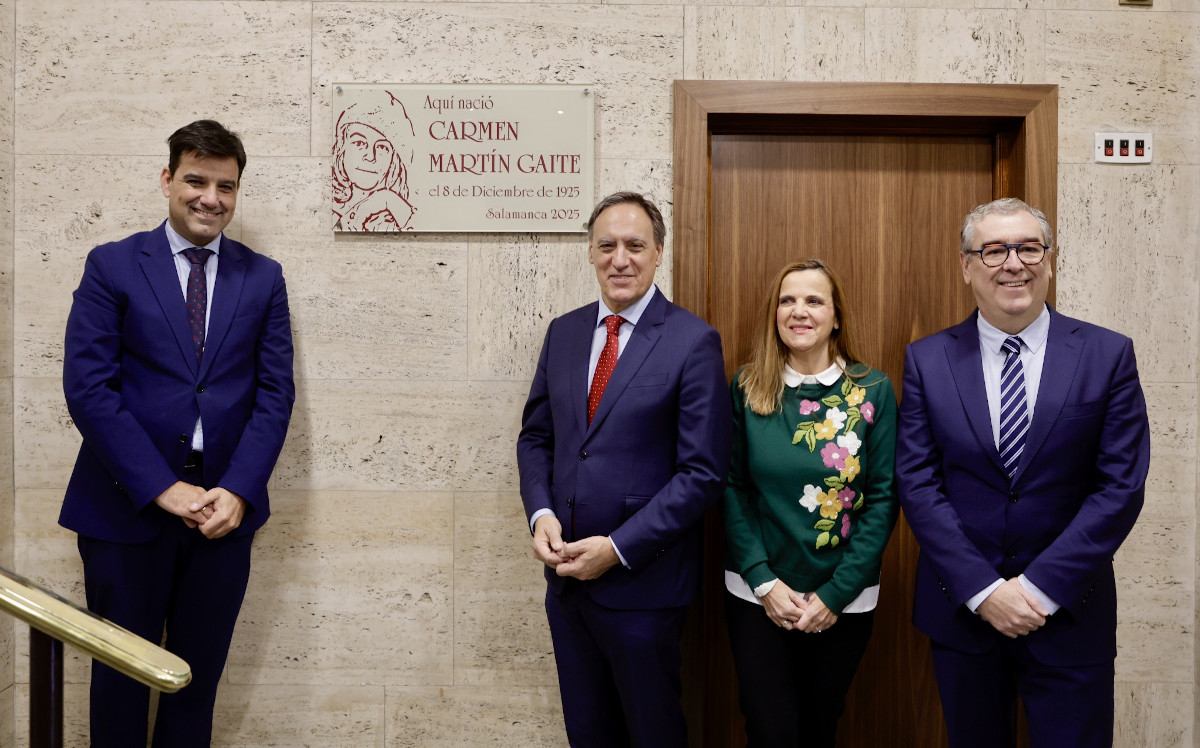
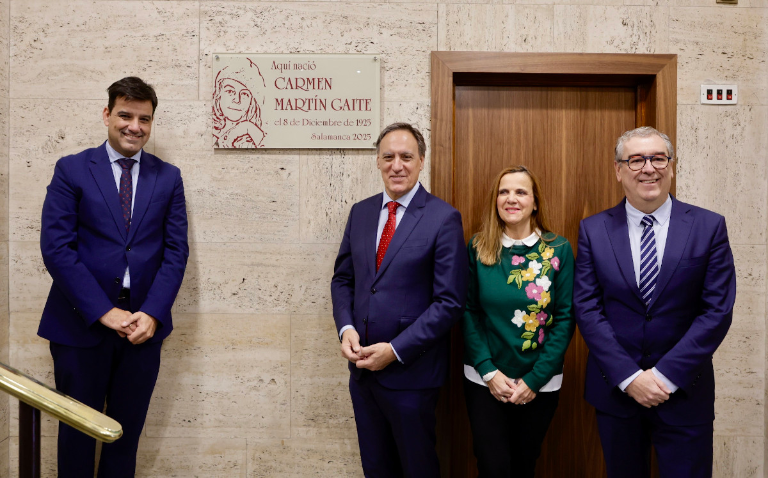
Unicaja joins in the commemorative events for the centenary of the birth of the writer Carmen Martín Gaite with the installation of a plaque on the façade of the bank's building in Plaza de los Bandos in Salamanca, where the Salamanca writer was born and lived.
The plaque was unveiled on Thursday, 4 December, at an event attended by the regional manager of Unicaja in Castilla y León, Manuel Rubio, as well as by the mayor of Salamanca, Carlos García Carbayo; the Secretary General of the University of Salamanca (USAL), Alfredo Ávila de la Torre, and USAL professor and coordinator of the blog on Carmen Martín Gaite, Esther del Brío.
The bank is showing its support for the figure and work of one of the most important Spanish writers of the 20th century, whose 100th birthday will be celebrated on 8 December. To commemorate this, various institutions have held numerous events and activities throughout the year to highlight the artist's legacy.
Unicaja, aware of the importance of culture as a pillar of progress, cohesion and external projection for Castilla y León, thus reinforces its social commitment to the region, which it demonstrates through its collaboration in the organisation and promotion of various activities throughout the community.
This support, which is part of Unicaja's sustainability policy, contributes both to strengthening the social fabric and enriching the cultural life of the region, a territory with which the organisation has a special connection.
About Carmen Martín Gaite
Carmen Martín Gaite was born on 8 December 1925 in Salamanca. She studied at the city's girls' secondary school, where teachers Rafael Lapesa and Salvador Fernández Ramírez inspired her literary vocation.
She studied Romance Philology and in 1948 moved to Madrid to pursue her doctorate. In the capital, she would meet other writers who would form part of the so-called 'generation of the 50s': Ignacio Aldecoa, Jesús Fernández Santos, Medardo Fraile, Josefina Rodríguez, Alfonso Sastre and Rafael Sánchez Ferlosio, whom she would later marry.
Thus began a prolific literary career that would lead her to cultivate a multitude of genres, including novels, short stories, plays and essays. In 1954, she published her first work, El balneario, which received the Café Gijón Prize, and in 1958 she won the Nadal Prize with the novel Entre visillos (Behind the Curtains), a chronicle of bourgeois youth in the provinces of post-war Spain.
Her career also includes literary translations of works by authors such as Italo Svevo, Emily Brontë, Virginia Woolf and Gustave Flaubert, as well as lectures, articles and children's books, which earned her numerous awards and recognitions, such as the Prince of Asturias Award in 1988; the Castilla y León Prize for Literature in 1992, and the National Prize for Spanish Literature in 1994, for her entire body of work. She died in Madrid in the summer of 2000.