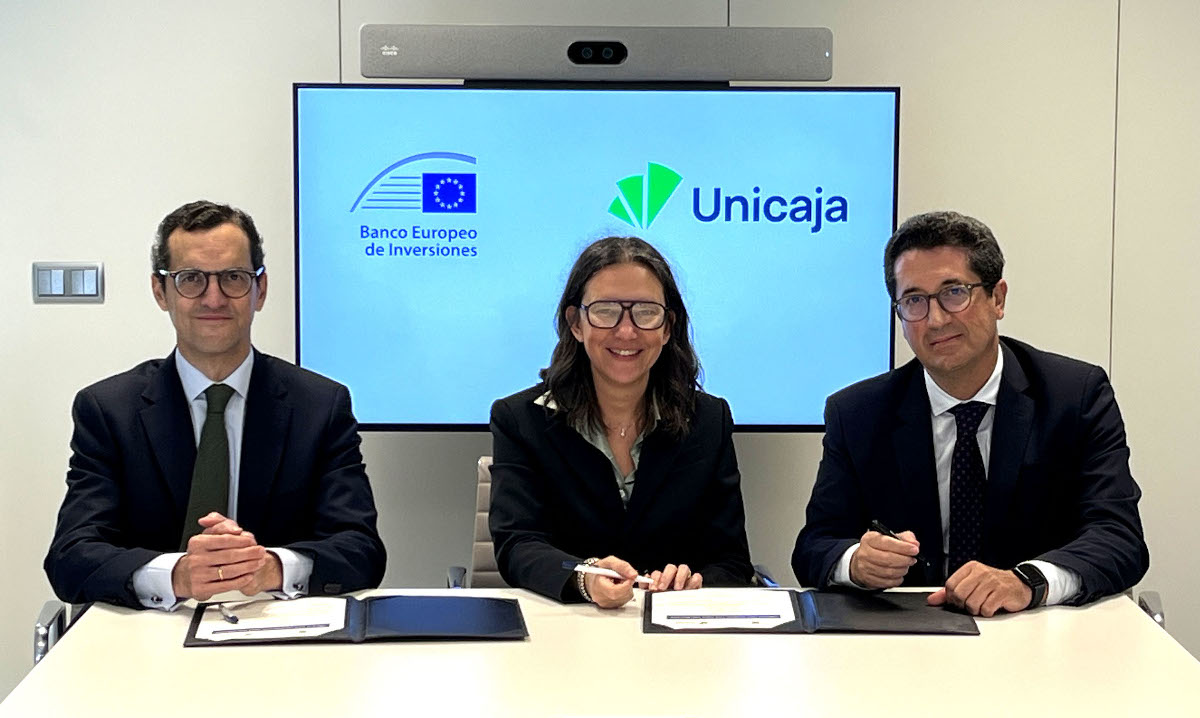
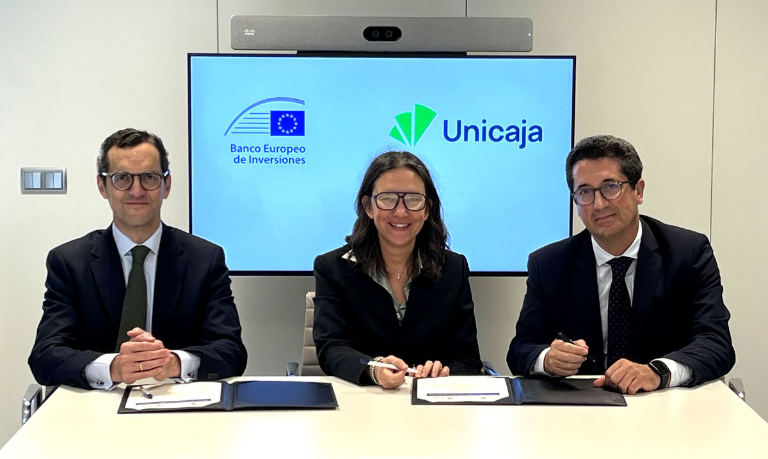
The European Investment Bank (EIB) and Unicaja have signed a guarantee agreement for €200 million, enabling Unicaja to unlock up to €400 million in new financing to back Spanish SMEs and mid-caps, with a focus on cohesion regions.
The goal is to expand the range of financing available to these companies so that they can make investments that strengthen their competitiveness and resilience, contributing to their growth and job creation. The financing can also be used to cover the companies' liquidity needs.
This is the first guarantee agreement signed between the EIB and Unicaja and represents another step forward in the European Investment Bank's working relatioship with all financial intermediaries to direct financing to the backbone of the Spanish productive fabric, which is made up of SMEs and midcaps. Approximately 60% of the beneficiary companies are expected to be located in cohesion regions.
"This agreement with Unicaja strengthens the commitment of both of our institutions to supporting the competitiveness and resilience of Spanish SMEs. Mobilising €400 million in new financing will enable these companies to make investments that are key to their growth and job creation, particularly in cohesion regions," said EIB Director of Financial Institutions Gemma Feliciani.
"For Unicaja, backing the growth and competitiveness of SMEs is not just a priority: it is part of our strategic vision. Our cooperation with the EIB reinforces this commitment and means we can take yet another step forward in this direction. This new agreement will enable us to offer more flexible financial solutions tailored to each company’s reality, helping them to turn their projects into concrete opportunities," said Unicaja Director General of Business Banking Jesús Ruano. "This agreement will drive a greater number of larger projects, while maintaining rigorous risk control. Our goal is clear: bolstering industry and having a long-term positive impact on society."
This agreement with Unicaja once again demonstrates the EIB Group’s role in promoting financial instruments like guarantees, helping to unlock capital to boost projects that support SMEs, reduce risk exposure for financial institutions and strengthen the EU capital markets union, which is one of the EIB Group's eight strategic priorities. The agreements also contribute to another of the EIB Group’s strategic priority, namely economic, social and territorial cohesion in the EU.
About EIB
The European Investment Bank (EIB) is the long-term financing institution of the European Union, owned by its Member States. Built around eight core priorities, the EIB finances investments that pursue the EU's strategic objectives by bolstering climate action and the environment, digitalisation and technological innovation, security and defence, cohesion, agriculture and bioeconomy, social infrastructure, the capital markets union and a stronger Europe in a more peaceful and prosperous world.
The EIB Group, which also includes the European Investment Fund (EIF), signed nearly €89,000 million in new financing for more than 900 high-impact projects in 2024, boosting Europe's competitiveness and security.
Around half of EIB financing in the European Union goes to cohesion regions, where per capita income is below the EU average, while almost 60% of annual EIB Group investments support climate action and environmental sustainability.
In Spain, the EIB Group has signed new financing worth €12,300 million for over 100 high-impact projects in 2024, contributing to the country's green and digital transition, economic growth, competitiveness and better services for its people.
About Unicaja
Unicaja is one of the leading banks in the Spanish financial system and a listed company on the IBEX 35, with a solid base of four million customers. In fact, it is a leading institution in six autonomous communities, its regions of origin (Andalusia, Asturias, Cantabria, Castile-La Mancha, Castile and León, and Extremadura), and has a significant presence throughout the country.
It is characterised by its universal banking and sustainable business model, under prudent management of its commercial strategy and risk profile, socially responsible, which places quality, innovation and digital transformation at the forefront, and incorporates technology to improve customer service and the efficiency of the institution.