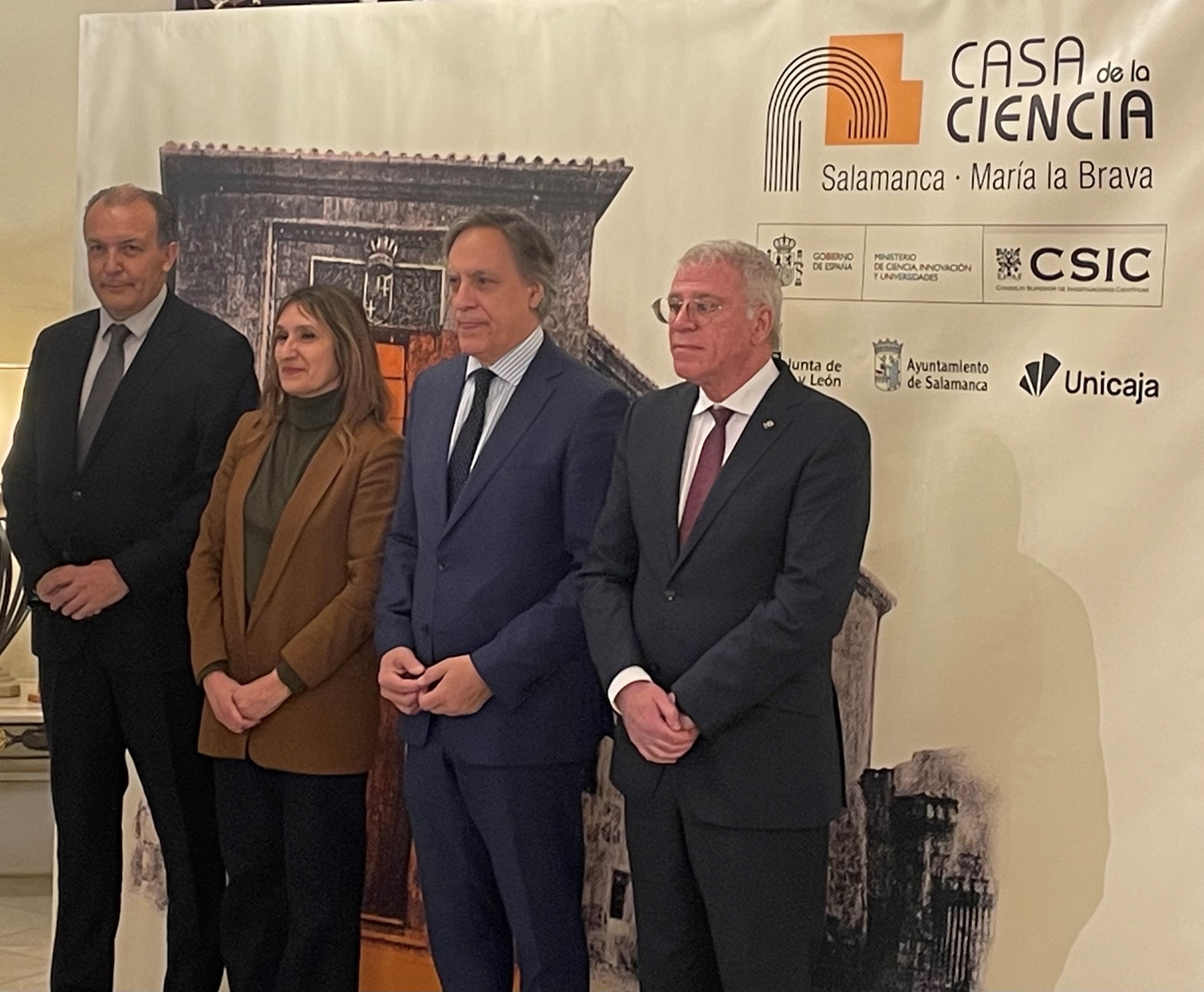
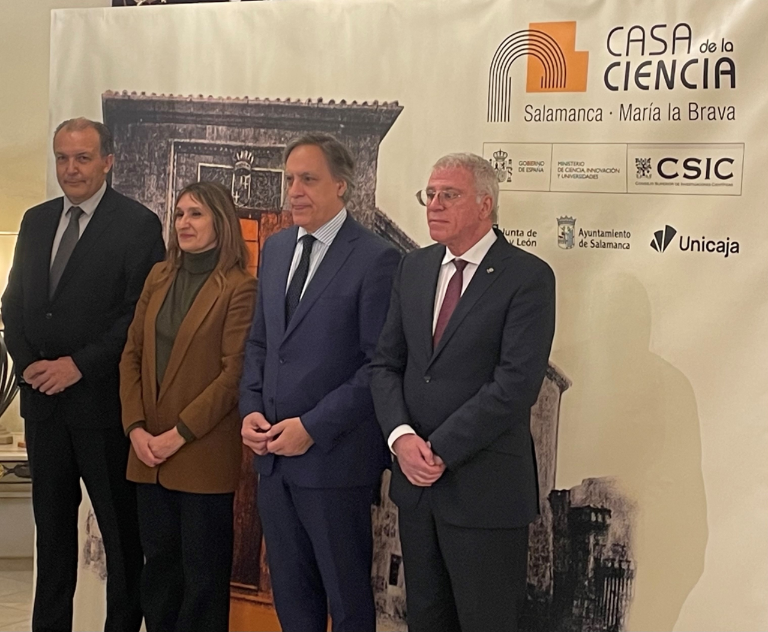
Unicaja, the Consejo Superior de Investigaciones Científicas (CSIC), the Town Hall of Salamanca and the Junta de Castilla y León have signed today the agreement that establishes the start-up of the Casa de la Ciencia del CSIC ‘María la Brava’ in Salamanca, a space open to the public, which is born with the mission of becoming a reference in scientific culture in Salamanca and Castilla y León, promoting access to science in an accessible and innovative way.
The signing ceremony, held today at the Salamanca Town Hall, was attended by Carlos Closa Montero, Vice President of Organization and Institutional Relations of the Consejo Superior de Investigaciones Científicas; Rocío Lucas Navas, Regional Minister of Education of the Junta de Castilla y León; Carlos García Carbayo, Mayor of Salamanca, and Alberto Gurrionero, Unicaja’s Deputy Regional Manager of Castilla y León Sur.
During the signing ceremony, the representatives of the four institutions emphasized the key role that the future Casa de la Ciencia will play as a meeting place for citizens and the scientific community, offering a place where knowledge and history will go hand in hand in an emblematic setting.
In addition, it aims to strengthen collaboration with the different actors in the R&D&I system, promoting synergies and joint projects, for example, in citizen science. Its main goals include to increase the visibility and projection of the research carried out by the CSIC in Castilla y León, as well as to serve as a meeting point for researchers, technologists and creators of the community.
With a strong social commitment, the Casa de la Ciencia will seek to bring research work closer to the general public, promoting a society that is more informed and participates in science. To this end, it will offer educational and informative activities and workshops of a permanent nature, which will be adapted to different age groups. These activities will be based on scientific rigor, sustainability and respect for the environment, combining pedagogy, entertainment and dissemination from a cultural perspective, as stated in the agreement.
With the signing of this agreement, the institutions involved reaffirm their commitment to research, education and the advancement of knowledge as fundamental pillars for the development of society.
The agreement signed today is a continuation of the general action protocol signed on 14 September 2022, in which these institutions laid the foundations for collaboration for the creation of the new Casa de la Ciencia del CSIC in the city.
History, science and avant-garde at the Casa de María la Brava
The Casa de Doña María la Brava is an emblematic 15th century building located at number 5, Plaza de los Bandos, in the heart of the historic center of Salamanca and just 250 meters from the Plaza Mayor. Declared a historic-artistic monument, the building was acquired and restored in 2008 by Unicaja for use as a museum space.
The building, with four floors and a usable area of 1,282 square meters, retains the essence of the noble houses of the second half of the fifteenth century, although its interior has been completely remodeled. Throughout the 20th century, it housed a high school and the facilities of the Colegio Farmacéutico Salmantino.
The name of the house honors Doña María Rodríguez de Monroy, known as “La Brava”, a member of an influential family from Salamanca in the 15th century. During the Guerra de los Bandos, in which different factions fought for control of the city, her sons were murdered. Seeking revenge, Doña María pursued those responsible, ordered their execution and deposited their heads in her sons' tombs. This act marked her legend and made her a historical character remembered for her determination and implacable character.
With the creation of the new Casa de la Ciencia, this historic space will be enhanced, which will complete the Salamanca museum offer in terms of scientific culture with the experience, background and research quality accredited by the CSIC - the largest Spanish research organization and the seventh largest in the world - without losing sight of art and the avant-garde.