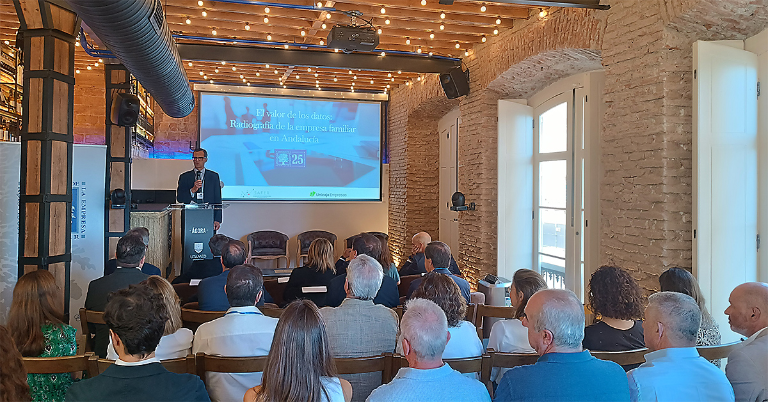
The family business is not only the predominant business model in Andalusia; it is also one of the main drivers of economic growth and territorial cohesion in the region. Unicaja, through Unicaja Empresas, has supported the presentation of this study, which quantifies this significance, as 92.3 per cent of Andalusian businesses are family-owned and generate 78.4 per cent of business employment and 77.4 per cent of the region’s Gross Value Added (GVA) – figures that cement this model as the true backbone of Andalusia’s productive fabric.
This is confirmed by the study on family businesses in Andalusia, presented by the Andalusian Association of Family Businesses (AAEF, Asociación Andaluza de la Empresa Familiar), in collaboration with Unicaja Empresas and compiled by the Spanish Society of Family Business Researchers (SAFER, Sociedad Española de Investigadores en Empresa Familiar), which breaks down the data from the report ‘Relevance and Survival of Family Businesses in Spain 2025’ by the Institute of Family Business (IEF) at a regional level.
During the presentation of the report, which was attended by Unicaja’s Director General of Corporate Business, Jesús Ruano, it was noted that Andalusia is home to nearly 230,000 family businesses, accounting for 16 per cent of Spain’s business sector. Their presence exceeds 90 per cent in all Andalusian provinces and spans virtually all sectors of activity, from industry and commerce to construction, tourism and the agri-food sector. Even amongst large companies, six out of ten firms with more than 250 employees remain family-owned, dispelling the notion that this model is limited to small and medium-sized enterprises.
Competitiveness
The study does not merely measure their economic weight. It also shows that family businesses exhibit better indicators of competitiveness. Despite being, on average, smaller than non-family-run firms, they achieve higher levels of economic and financial profitability, maintain a more robust structure, have lower levels of debt and boast a higher survival rate, which strengthens their ability to cope with uncertain scenarios and invest with a long-term vision.
In short, to speak of business in Andalusia is to speak of family businesses, and without them it would be impossible to envisage a future for Andalusia. Family businesses dominate the Andalusian business landscape; they are deeply rooted in the region, shape civil society, and contribute to wealth, employment, well-being, identity and the future.
Furthermore, the analysis confirms the predominantly young profile of Andalusian family businesses, as more than two-thirds of them have been in existence for less than 25 years, with 20.2 per cent in the start-up phase (less than 10 years old) and 48.1 per cent still in the development phase (between 10 and 25 years old). 31.8 per cent can already be considered established, and only 1 per cent have been in operation for over half a century. These figures suggest that almost one in three family businesses has already undergone a generational handover.
Family businesses employ more than 2.1 million people, accounting for 78 per cent of total employment generated by Andalusian businesses as a whole. They generate 77.8 per cent of Andalusia’s GVA and contribute a higher proportion of corporation tax relative to their profits (EBITDA).
According to Florencio Chacartegui, Vice-President of the Andalusian Family Business Association, “this study not only puts figures to a well-established reality, but also reflects the true nature of the Andalusian family business: companies that grow with a long-term vision, invest in people and maintain a firm commitment to their local area. These are businesses that do not think in the short term, but in terms of generations, and which combine competitiveness with deep-rooted local ties to make a decisive contribution to the economic and social development of Andalusia”.
‘The Value of Data’
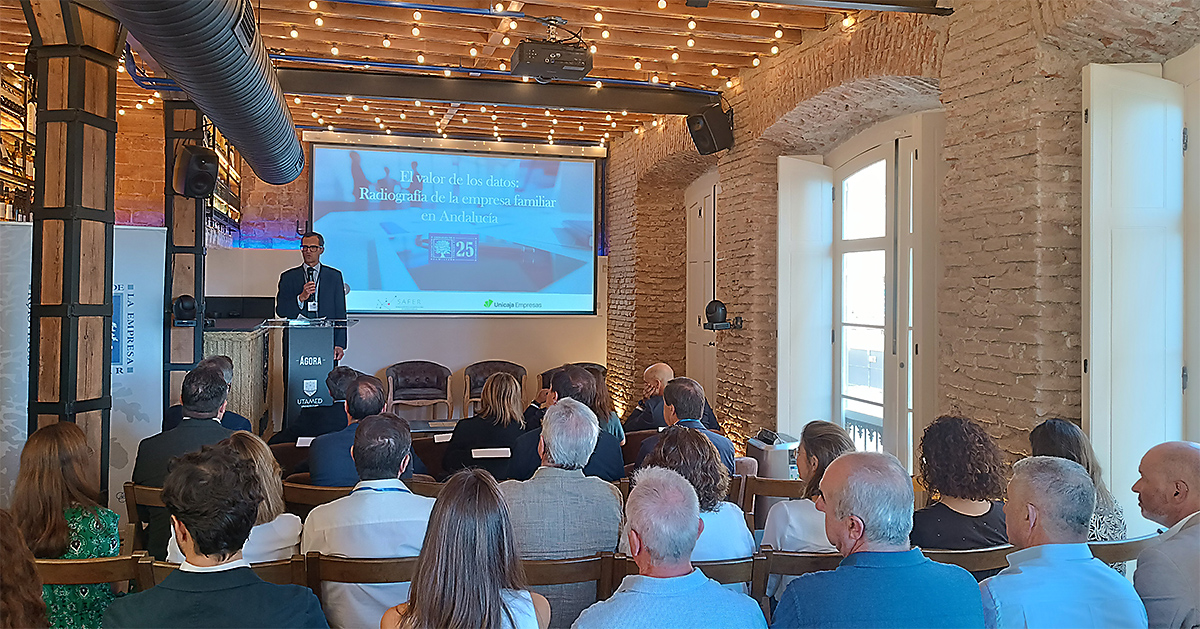
The presentation of the study took place during the conference ‘The Value of Data: An In-Depth Analysis of Family Businesses in Andalusia’, organised by the AAEF, in collaboration with SAFER, and sponsored by Unicaja Empresas, in the Ágora hall at UTAMED, in Málaga.
The official opening was led by the AAEF’s vice-president, Florencio Chacartegui, and Unicaja’s Director General for Business, Jesús Ruano. Subsequently, the president of SAFER, José Carlos Casillas, outlined the report’s main conclusions.
The event also featured a panel discussion moderated by journalist Ángel Recio, with contributions from Paz Hurtado, Chair of Hutesa; Francisco Gómez, Chair of Alfil Patrimonial Socimi; and Vicente Martín, head of Expansion at Grupo MAS, to analyse how the use of data can help improve the competitiveness of family businesses and strengthen their contribution to Andalusia’s economic development.