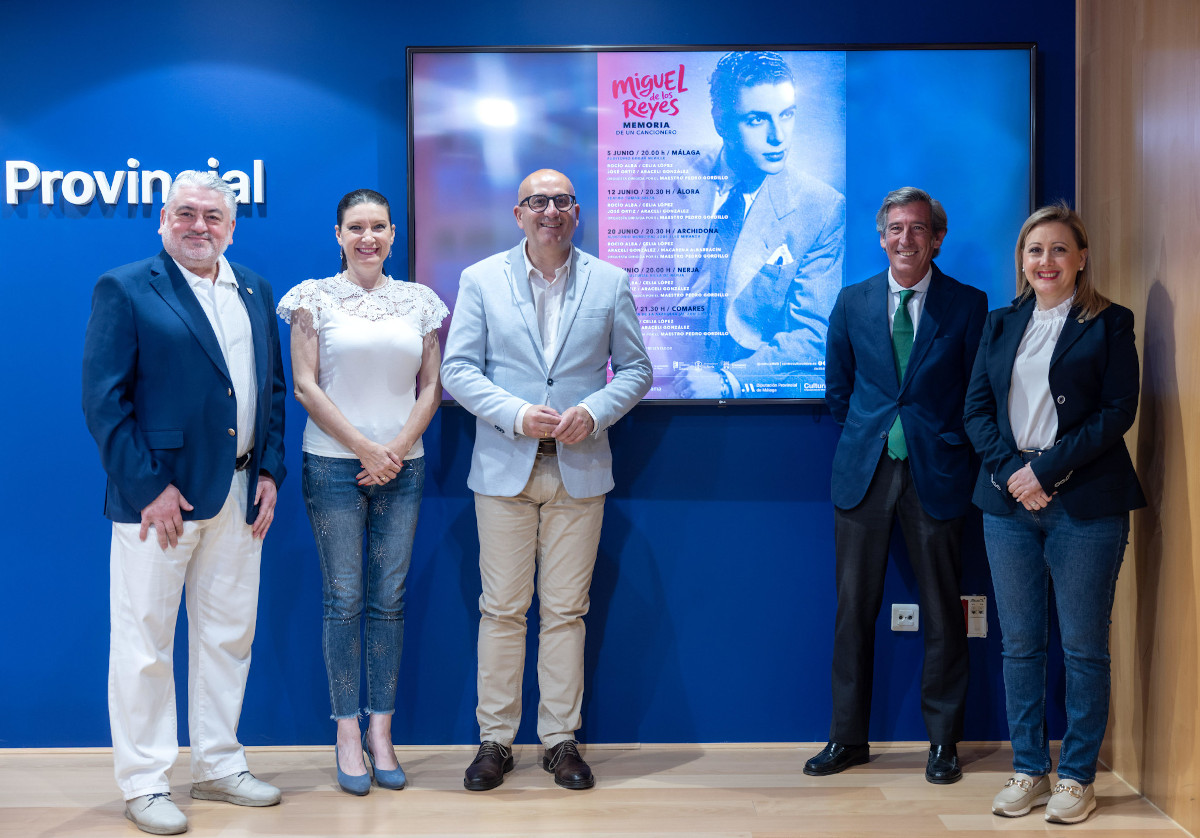
In June and July, Unicaja and Málaga Provincial Council will bring Spanish song to five municipalities in the province with the show ‘Miguel de los Reyes, memory of a songbook’, which pays tribute to this Málaga-born artist on the 27th anniversary of his death.
The tour will begin on 5 June at the Edgar Neville Auditorium in Málaga (Calle Pacífico, 54), and will visit Álora (Teatro Tomás Salas) on 12 June; Archidona (‘José Luis Miranda’ Municipal Auditorium) on 20 June; Nerja (Villa de Nerja Cultural Centre) on 27 June; and Comares (Plaza Balcón de la Axarquía) on 3 July. Admission is free at all venues.
The show will feature Rocío Alba, Celia López, José Ortiz, Araceli González and Macarena Albarracín, accompanied by the orchestra conducted by maestro Pedro Gordillo, who has composed the musical arrangements and some previously unpublished lyrics that will be premiered on this tour. The concerts will be presented by journalist Pepelu Ramos.
The vice-president of the Provincial Council and councillor for Culture, Manuel López Mestanza, and the head of Institutional Business at Unicaja’s Corporate Banking, Joaquín Ruiz del Portal Lázaro, presented the programme on Wednesday, alongside Maestro Gordillo, the show’s creator.
López Mestanza thanked Unicaja for sponsoring this event, as part of the collaboration agreement signed between the two institutions and within the ‘Sentimiento y tradición’ programme, which “encompasses flamenco and copla, two Andalusian art forms that are very popular with the people of Málaga”, he emphasised.
For his part, the Unicaja representative remarked that the financial institution, “as part of its sustainability policy and through a banking approach that is accessible and committed to people, works to promote initiatives that allow citizens to enjoy a wide-ranging and high-quality cultural offering”. He also noted that, “for Unicaja, it is a pleasure to collaborate with an event that helps to preserve and promote an art form so closely linked to our roots as the copla”, whilst acknowledging the work of the Provincial Council in “bringing culture and popular traditions to all the municipalities in the province”.
During his speech, Pedro Gordillo described the show as “exciting” and “in the traditional style”. As for Miguel de Los Reyes, he highlighted “his global impact, as one of the great songwriters that copla has produced”. He also emphasised that “he must be studied from different angles: as a flamenco dancer, a singer and as a lyricist, who signed his work as ‘Quesada’”.
Singer, dancer and songwriter
Miguel de los Reyes was one of the most important artists in Spanish song and a guardian of the old flamenco styles of Málaga. A singer, dancer and songwriter – as Jacinto Benavente christened him – he was the ninth of the 16 children born to Lola and Pepillo ‘El Guasa’, as his father was affectionately known.
He made his stage debut at the Teatro Olimpia in Málaga alongside Imperio Argentina, Margot and Chiberto. Thanks to Pastora Imperio, he moved to Madrid to work at the Teatro Fuencarral, where Pepe Marchena, Manolo el Malagueño, Ramón Montoya and other artists were performing. From there, Estrellita Castro took him to her show ‘Romería’, and shortly afterwards he moved to the Los Chisperos café in Tirso de Molina, forming a duo with Tomás de Antequera.
In just a few years, he went from being a young singer arriving from the provinces to becoming one of the leading figures in show business. He recorded dozens of albums and appeared in a number of films. His first film, ‘El mucamo de la niña’, was shot in Argentina with Lolita Torres. Later, he worked on ‘La guitarra de Gardel’ with Carmen Sevilla; in ‘El amor brujo’ he starred alongside Pastora Imperio, and in ‘Guardabarreras’ with Antoñita Colomer.
With Concha Piquer’s company, he travelled to Argentina, then to Havana, where he triumphed at the CMQ. He went on to Santiago de Chile to work at the Sala Goyesca, and then back to Buenos Aires, where he met his fellow countryman Miguel de Molina, eventually staying at his home in Belgrano. While working in Montevideo alongside Carmen Amaya and Miguel de Molina, traffic came to a standstill due to the crowds of people trying to reach the theatre.
Perhaps his most memorable work was the Ballet de Arte Español, featuring a cast of eight men and ten women, including singers, dancers, guitarists and clappers, forming an unrivalled troupe that toured Spain on several occasions. It was a period that surpassed even those in which he worked with Custodia Romero or Pastora Imperio.
He also toured the country with ‘Suspiros de España’, featuring Pericón de Cádiz, Macarena del Río, Blanca Suárez, Luisa Esteso, Pepito Vargas and other renowned artists. His final period was perhaps the quietest, as, apart from a few performances at tributes or festivals, he devoted his time to teaching dance and singing, particularly La Pirula’s bulerías, and to his walks from the Peña Juan Breva to the El Chinitas restaurant and back. But this break did not prevent him from forming a new company with his brother Antonio de los Reyes, Cándido de Málaga, Andrés El Paquiro, Paca Vargas, Paco Rodríguez, Enrique Naranjo and other artists from Málaga.
Miguel de los Reyes, or Miguel Quesada Falcón, which were his first name and surname, passed away in Málaga, the city of his birth, on 27 January 1999.